By Grayson Holland
The average coffee table size in the United States is roughly 48 inches long, 24 inches wide and 16 to 18 inches high, though rectangular tables commonly fall between 40 and 60 inches in length. Round versions usually measure 30 to 42 inches across. These figures are a starting point, not a rule, because the right size depends on your sofa, your room and how you use the table.
Why There Is No Single Standard Size
Coffee tables have no industry-mandated dimensions, so manufacturers design them around typical sofa lengths and common room layouts. A table that looks ideal in a showroom can feel oversized in a compact apartment or undersized in a open-plan family room. The “average” numbers reflect what most furniture lines produce, not what fits every home.
Shopping for one? See our guide: 8 Best Coffee Tables for Living Room (2026): Expert Picks.
For a deeper look at how proportions work across room types, our guide on Coffee Table Sizing Guide: How to Choose the Right Size walks through the measuring steps in detail.
Factors That Change the Right Size
Four variables matter more than any average number:
- Sofa length. A table should generally be about two-thirds the length of the sofa it sits in front of. A 84-inch sofa pairs well with a table around 50 to 56 inches long.
- Clearance. Leave 14 to 18 inches between the sofa edge and the table so people can walk and reach comfortably.
- Seating height. The table top should sit roughly 2 to 4 inches below the top of the sofa cushion. Taller tables crowd the sitter; very low ones are hard to use from a deep sofa.
- Room footprint. In a small living room, a 36 to 40 inch table may be the most practical choice even if it is below average.
Shape also changes the calculation. A round table of 36 inches can feel similar in presence to a 48-inch rectangle, and it needs less clearance at the corners. Our comparison of Round vs Rectangular Coffee Tables covers how shape affects traffic flow.
Material and Visual Weight
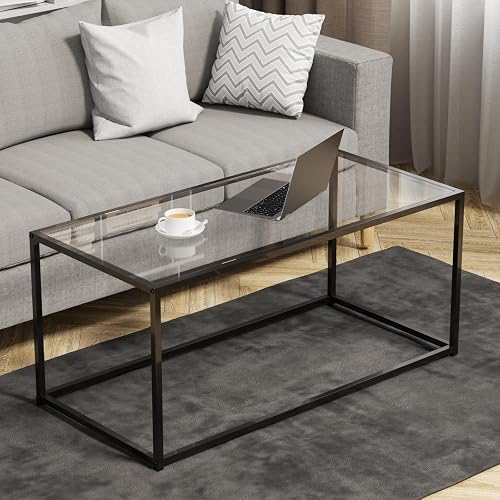
Two tables of identical dimensions can look very different. A solid wood top reads as heavier than a glass top with a thin metal frame, so a glass table may feel more open even at the same measurements. If you are weighing a glass option, our notes on The Advantages of Lightweight Glass Coffee Tables explain why lighter-looking pieces suit smaller rooms.
How to Choose Your Size
- Measure the sofa length and multiply by 0.65 to 0.70 for a target table length.
- Measure the gap from sofa to planned table position; aim for 14 to 18 inches.
- Check the height of the sofa seat cushion and subtract 2 to 4 inches.
- Tape the outline on the floor with painter’s tape and live with it for a day or two before buying.
- Confirm that doorways and walkways still have at least 30 inches of clear space.
Practical Tips for Odd-Sized Rooms
- If your sofa is short, choose a narrower table so the ratio stays balanced.
- In a room with two seating areas, a nesting set lets you adjust the footprint. See Nesting Coffee Tables Explained for sizing options.
- If you need extra surface without extra bulk, a lift-top design can work well. Our overview of Lift-Top Coffee Tables: A Guide to Styles and Uses explains the height trade-offs.
- Pair a lower table with side tables at matching heights for a cohesive setup; Pairing a Glass Coffee Table with Side Tables offers examples.
Related questions
Is a 48-inch coffee table too big for a small living room?
Not necessarily. If your sofa is around 72 inches long and you keep clearance at 14 inches, a 48-inch table still fits. Tape the footprint on the floor first to confirm.
How high should a coffee table be?
Most sources suggest 16 to 18 inches, which keeps the top 2 to 4 inches below the seat cushion. Adjust for unusually low or high seating.
Should a round coffee table be the same size as a rectangular one?
Not required. A 36-inch round table often occupies a similar visual area to a 48-inch rectangle, though the rectangle offers more surface.
Can I use a larger table in a big room?
Yes. Rooms over about 300 square feet can accommodate tables approaching 60 inches long. Keep proportions in mind so the table does not overwhelm the seating.
Do glass tables look smaller than wood ones?
Often they do, because the see-through top reduces visual bulk. The actual dimensions remain the same, so measure rather than rely on appearance.

About Grayson Holland
Grayson writes about living-room tables. Each guide starts with research into how products are built and what owners report after months of use, and is revised when better options appear.