By Grayson Holland
Most coffee tables fall into a handful of standard footprints. Rectangular tables commonly run 40 to 50 inches long and 20 to 30 inches wide, round tables usually measure 30 to 42 inches across, and square tables often land between 30 and 36 inches per side. Height is the other half of the picture, with most designs sitting 16 to 20 inches off the floor. These common coffee table sizes give you a reliable starting point before you account for your sofa and room.
Why standard coffee table sizes cluster where they do
Coffee table dimensions are not random. They follow the average sofa, the typical distance a person can comfortably reach across, and the walking clearance most homes need. A seated adult’s forearm reaches roughly 20 to 24 inches, which is why tables rarely go much deeper than 30 inches. Because most sofas measure about 84 to 90 inches long, a table in the 40 to 50 inch range leaves comfortable space at each end without crowding the seating.
Shopping for one? See our guide: 8 Best Coffee Tables for Living Room (2026): Expert Picks.
Height is tied to seat height. Most sofa seats sit between 16 and 18 inches from the floor. A coffee table set roughly 2 to 4 inches lower than the seat cushion is easy to reach and does not block views when people sit down. That is why 16 to 18 inches is the most common range, with taller and shorter options appearing mainly in specialty designs.
The main factors that change the right size
Standard sizes are a baseline, and several variables should push you up or down from the average:
- Sofa length: A 60-inch loveseat pairs best with a table around 30 to 36 inches long. A 96-inch sectional may call for 50 to 60 inches.
- Room size: In a room under 150 square feet, a smaller table in the 30 to 40 inch range keeps traffic paths open. Larger rooms can handle 48 inches or more.
- Seating arrangement: If you have chairs on the far side, leave 14 to 18 inches between the table edge and each seat for comfortable legroom.
- Shape: Round tables soften tight spaces, while rectangular tables suit sofa-facing layouts. Our piece on Round vs Rectangular Coffee Tables covers that tradeoff in more detail.
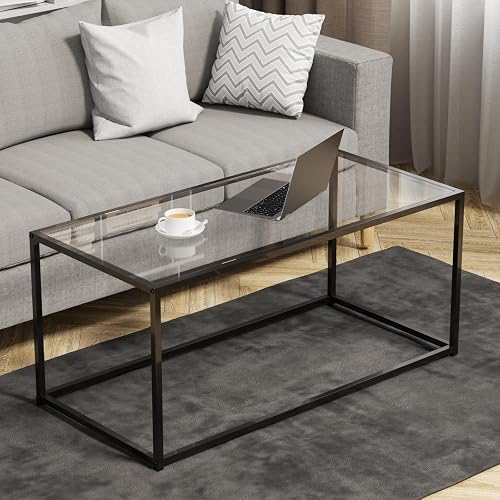
- Visual weight: Glass tops and open bases look lighter, so you can often go a few inches larger without the room feeling heavy.
How to choose the right size for your space
Start by measuring the sofa and noting the space in front of it. Then follow these steps:
- Measure the sofa length and divide by two to find a target table length, adjusting toward the lower end for small rooms.
- Mark the table footprint on the floor with painter’s tape to check how it sits in the room.
- Leave at least 14 to 18 inches between the table and the sofa for knee room and reaching.
- Keep 30 to 36 inches of walking clearance around the rest of the room so traffic moves freely.
- Match the table height to the seat cushion height, staying within about 2 to 4 inches below.
- Check the height against the arm height of your sofa so the surface feels approachable when seated.
For a deeper walkthrough of this process, see our Coffee Table Sizing Guide: How to Choose the Right Size, and for room-by-room figures, check Average Coffee Table Measurements: Sizes by Room and Sofa.
Common mistakes to avoid
The most frequent error is buying a table that is too small for the sofa. A 30-inch table in front of a 90-inch sofa can look lost, and it gives little room for drinks and books. The reverse is also true: a 60-inch table can block the walkway in a compact room. Another common issue is ignoring height. A table that sits higher than the seat cushion can feel awkward and make reaching for items harder.
Practical tips for small spaces
- Consider a nesting set so you can pull out a larger surface when needed. Our guide to Nesting Coffee Tables Explained explains how they work.
- Look at a small glass coffee table to keep sightlines open in tight rooms.
- Use a side table alongside a smaller center table rather than forcing one oversized piece to do everything.
- Choose lighter materials when you need to move furniture often.
Related questions
What is the most common coffee table length?
Rectangular coffee tables most often measure between 40 and 50 inches long, which suits the typical three-seat sofa.
How tall should a coffee table be?
Most coffee tables fall between 16 and 20 inches tall, generally 2 to 4 inches below the sofa seat cushion.
Can a coffee table be too big?
Yes. If the table leaves less than about 14 inches of clearance to the sofa or blocks walkways, it is likely too large for the room.
What size coffee table goes with a loveseat?
A table around 30 to 36 inches long usually pairs well with a loveseat that measures about 58 to 66 inches.
Are round coffee tables a standard size?
Round tables commonly range from 30 to 42 inches in diameter, with 36 inches being a frequent choice for medium rooms.
Related reading
- What Are Common Coffee Table Dimensions? Standard Sizes Explained
- What Is the Average Coffee Table Size? Dimensions and How to Choose
- Round Table Coffee Table: How to Choose the Right Size and Style

About Grayson Holland
Grayson writes about living-room tables. Each guide starts with research into how products are built and what owners report after months of use, and is revised when better options appear.