 By Claire Whitaker
Updated November 2026
An end table vs coffee table comparison comes down to where the piece sits and what it has to do. A coffee table is the anchor for a sofa grouping, usually placed in front of the seating at a height that keeps drinks and remotes within reach. An end table is a smaller piece set beside a sofa, armchair or corner, built for a lamp, a phone or a single cup. If you have room for a central surface and need a place to hold everyday items, the coffee table wins. If your space is tight, your seating is pushed against a wall, or you already have a central table, an end table is often the better buy.
| Criterion | Coffee Table | End Table |
|---|---|---|
| Typical placement | Centered in front of a sofa | Beside a sofa, chair or bed |
| Common height | About 16 to 20 inches | About 20 to 26 inches |
| Common top size | About 36 to 54 inches long | About 18 to 24 inches across |
| Main job | Central surface for drinks, decor and shared items | Personal surface for a lamp, phone or cup |
| Storage | Shelves, drawers or lift-top options | Usually one drawer or a small shelf |
| Best for small rooms | Works if clearance is at least 14 to 18 inches | Easier to fit into narrow or cramped corners |
| Footprint flexibility | Limited; needs open floor space | High; can be paired, staggered or moved |
Height and Reach: Which Table Is Easier to Use?
Height decides whether a table feels useful or awkward. Manufacturers and furniture guides commonly place coffee tables somewhere around 16 to 20 inches tall, which matches the seat height of most sofas. That lets you set down a mug without leaning forward too far. End tables are generally taller, often between 20 and 26 inches, so the top sits level with the arm of the sofa. That height suits a table lamp or a phone resting next to you.
Winner: Tie, depending on seating. If your sofa is low and deep, a coffee table keeps items in reach. If you sit in an upright chair or a bed, an end table at arm height is more comfortable. Measure from the seat cushion to the arm before you buy, and match the table to that line.
Size and Footprint: Which Fits a Small Living Room?
A coffee table needs open floor space. Most layouts call for 14 to 18 inches between the front of the sofa and the table edge so people can walk around it and get up without bumping into it. Many coffee tables also need a clear path of about 30 inches on the sides. That is a lot of room to give up in an apartment or a narrow living room.
An end table has a much smaller footprint, often 18 to 24 inches across, and it can slide into a corner or sit flush against the arm of a sofa. You can also use two of them to balance a sectional or a loveseat.
Winner: End table. It fits more layouts and leaves more walking space. If you have a compact room, a pair of end tables often looks more deliberate than one oversized coffee table that crowds the seating. For room-by-room sizing guidance, see What Is the Average Coffee Table Size? Dimensions and How to Choose.
Storage: Which Option Holds More Without Clutter?
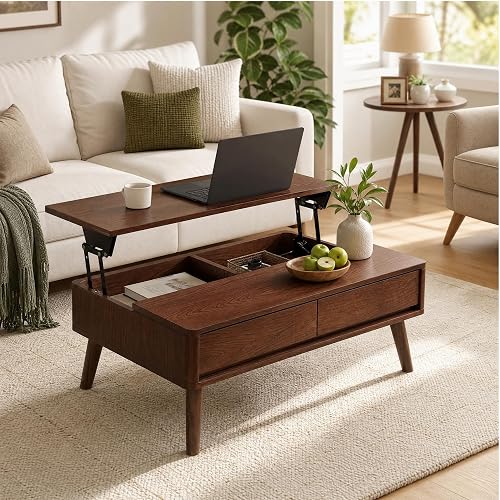
Coffee tables generally offer more storage capacity. Many include open shelves for books or baskets, a lower shelf for throw blankets, or drawers for remotes and coasters. Some styles, including lift-top models, hide a larger work or serving surface inside the frame. If you want a place to store games, magazines or a laptop, this is the stronger choice. Open-Shelf vs. Closed Storage Coffee Table Comparison covers the tradeoffs between these two storage styles in more detail.
End tables usually have one drawer or a single lower shelf, which is enough for a charger, a small notebook or a box of tissues. They are not built for bulk storage.
Winner: Coffee table. It offers more usable storage per piece. An end table is better at holding a few personal items than acting as a catch-all.
Styling and Visual Balance: Which Looks Better?
A coffee table sets the visual center of a seating arrangement. It usually carries the most decorative weight, with a tray, a plant, a stack of books or a bowl. Because it is large, its material and shape matter. A glass top, for example, can make a room feel more open, while a solid wood top adds warmth. If you are weighing materials, Glass vs Wood Coffee Tables explains how each one changes the look of a space.
End tables work as supporting pieces. Their job is to balance the room, not dominate it. Matching a pair of end tables to the sofa creates symmetry, while mismatched styles can make a space feel more relaxed and collected. Keep the top of the end table within a few inches of the sofa arm height so the lamp and the seating feel connected.
Winner: Coffee table for a focal point; end table for balance. If your room needs an anchor, choose a coffee table. If you want flexible, layered styling, end tables do more of the work.
Cost of Ownership and Maintenance: Which Is Easier to Care For?
Coffee tables have more surface area and more parts, so they show dust, fingerprints and water rings more readily. Glass tops need regular cleaning, and wood tops need coasters and occasional refinishing. Lift-top and storage models add hinges and drawer slides that need periodic checks. Glass and other tempered-surface pieces should be inspected for chips and cracks, since damaged glass should be replaced rather than repaired.
End tables are smaller and simpler, which means less to clean and fewer moving parts. That said, a small top can tip more easily if it is lightweight and has a narrow base, so check stability before placing a lamp on it.
Winner: End table. It is less work to keep clean and less likely to need hardware repairs.
Flexibility and Future Moves: Which Adapts Better?
End tables are easy to move between rooms. You can place one beside a bed, use another in an entryway or pair them with a different sofa after a move. A coffee table is tied more closely to a specific seating layout. If you change your sofa or rearrange the room, a coffee table may no longer fit the new footprint.
Winner: End table. It is the more portable and reusable piece.
Which Should You Choose?
- Choose a coffee table if you have at least 14 to 18 inches of clear floor space in front of your sofa and you want a central surface for drinks, decor or storage.
- Choose a coffee table if you entertain often and need a shared surface that seats the whole room’s reach.
- Choose an end table if your sofa sits against a wall or your room is narrow and every inch of walking space counts.
- Choose an end table if you need a dedicated spot for a lamp, phone or cup beside a chair or bed.
- Choose two end tables if you want symmetry on either side of a sofa or a bed without adding a central piece.
- Choose an end table if you rearrange furniture often or plan to move the piece between rooms.
If you are building a full set, 7 Best Coffee Table and End Tables Sets for Living Rooms (2026) shows how the two pieces are often sized to work together.
Shopping Options
For a coffee table, look at a classic rectangular design with a lower shelf for easy access to storage. Many owners find this style the most practical for daily use: View on Amazon.
For an end table, a compact design with a single drawer keeps the piece functional without taking up much room: View on Amazon.
FAQ
Can I use an end table in place of a coffee table?
Yes, if your seating is small or your room is tight. An end table will hold a few drinks and a remote, but it will not offer the same central surface or storage. If you entertain often, a coffee table usually serves better.
How far should a coffee table be from the sofa?
A common guideline is 14 to 18 inches between the sofa and the table. This gives enough room to sit and stand comfortably while keeping items within reach. Measure your own walkway before deciding.
What height should an end table be next to a sofa?
Aim for a top that sits close to the sofa arm height, which is often in the 20 to 26 inch range for end tables. Matching the height keeps a lamp or phone at a comfortable reach from the seat.
Do I need both a coffee table and end tables?
Not always. A large sectional or a long sofa often benefits from both, since the coffee table centers the group and the end tables balance the arms. In a small room, a pair of end tables may be enough.
Is it safe to put heavy items on a glass end table or coffee table?
Glass tops are typically designed for everyday items, but manufacturers often specify weight limits. Avoid placing heavy objects on the edges, and check the product’s load rating. If you have concerns about structural safety or a damaged piece, consult a furniture professional.
Conclusion
The end table vs coffee table decision depends on your seating, your floor space and what you need the piece to do. A coffee table is the better choice for a central surface and more storage, provided you have the clearance. An end table fits smaller rooms, offers personal reach beside a chair or bed and moves easily between spaces. Measure your sofa and walkways first, then choose the piece that keeps your living room comfortable to use every day.
About Claire Whitaker
Claire Whitaker is part of our editorial team and reviews and edits our living-room tables guides, checking product details against manufacturer specifications and owner feedback.