 By Claire Whitaker
Updated November 2026
Decorating with nesting tables means arranging a set of stacked or tucked-together tables so they work as both functional surfaces and visual anchors. Done well, a nest adds height variation, storage for things you actually use, and a clear focal point without crowding the room. This guide walks through measuring, placing, layering and finishing a nest so it looks deliberate rather than improvised.
Measure the Space Before You Place Anything
Start with the sofa, not the table. Most people set the largest table in front of the couch and then try to fit everything else around it, which is backwards. Measure the distance from the sofa’s front edge to the spot where the nest will sit. A common guideline is 14 to 18 inches of clearance, which leaves room to reach a drink without leaning. Note the height of the sofa seat as well, since the top of the largest table should sit roughly level with or a few inches below the seat cushion.
Shopping for one? See our guide: Metal Round Nesting Tables Review: Features and Performance.
Choose a Layout That Matches the Room
Nesting tables can sit in three basic arrangements, and each one changes how the room feels.
- Stacked: tables pulled together in a tight pile. This reads as sculptural and works well when space is limited.
- Staggered: tables offset from one another so each top is partly visible. This shows off different finishes and heights.
- Separated: tables pulled apart and placed at two ends of a sofa or beside two chairs. This suits larger rooms and gives you two side surfaces.
In a small living room, a staggered arrangement usually gives the best balance of display and function. In a wide room with a long sofa, separated tables tend to look more natural.
Layer Height, Texture and Objects
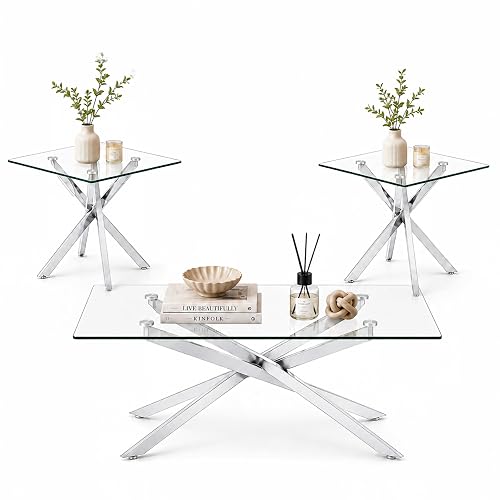
A nest looks flat when every top carries the same kind of object. Vary the height: put a tall item such as a small lamp, vase or stack of two books on the largest table, a medium object on the middle one, and a single small piece on the smallest. Mix textures too. Pair a glossy ceramic with a woven basket or a stone coaster, and avoid placing more than three decorative objects on any single top. Leave at least one surface partly empty so the eye has somewhere to rest.
Use Each Table for a Real Purpose
Decor works best when it sits on top of something useful. Keep a coaster, a remote or a book on the surface the sofa user can reach most easily, and reserve the highest, most visible table for one or two pieces that you only need to look at. For more ideas on balancing function and display, see Ideas for Decorating a Coffee Table: 9 Styling Steps That Work.
Finish the Look With Scale and Repetition
Once the tables and objects are placed, step back and check the room from the doorway. If the nest feels crowded, remove one object at a time until it breathes. If it feels thin, add a single larger piece rather than several small ones. Repeating one material or color across the nest, such as a brass accent on two tables, ties the set together. For a closer look at setting the tone with finishes, Antique Gold Nesting Tables: A Step-by-Step Guide to Choosing and Styling a Set covers metallic palettes in detail. If you are working with glass tops, Glass Nest Coffee Table: How to Choose and Style a Nesting Set (2026) explains how transparency changes the way objects read.
Checklist Before You Call It Done
- Measure sofa-to-table clearance (14 to 18 inches).
- Confirm the largest table top sits near seat height.
- Pick a layout: stacked, staggered or separated.
- Place one tall, one medium and one small object across the nest.
- Keep one everyday-use surface clear and reachable.
- Repeat one finish or color across at least two tables.
- Check the arrangement from the room entrance.
Common Mistakes
- Stacking all three tables flush against the sofa, which blocks legroom and makes the nest look heavy.
- Filling every surface with decor so nothing can be used.
- Choosing tables whose heights are too close together, which makes the set look like a single piece.
- Ignoring the rug: a nest that sits fully off the rug can look disconnected.
- Mixing too many finishes without a repeated element to link them.
Recommended Gear
- Felt pads for table feet: protect floors when you rearrange the nest often. View on Amazon
- Measuring tape: a flexible tape makes checking clearance and heights quick. View on Amazon
- Felt-bottom coasters: keep glass and metal tops from marking when drinks sit on them. View on Amazon
FAQ
How high should a nesting table be next to a sofa?
The top of the largest table should sit roughly level with the sofa seat cushion, or a few inches below it. Smaller tables in the nest can step down from there to create visual rhythm.
Can nesting tables work in a small living room?
Yes. Stacking the tables or using a staggered layout keeps the footprint small while still giving you two or three usable surfaces.
Should all the tables in a nest match?
They do not need to match exactly. A shared finish, shape or color is enough to make the set feel coordinated, and small variations add interest.
Conclusion
Decorating with nesting tables comes down to measuring first, choosing a layout that fits the room, and layering height and texture so each surface has a purpose. Keep one surface clear, repeat one finish, and step back to check the result. A well-arranged nest will hold a lamp, a drink and a book without ever looking cluttered.
Related reading
Ready to choose one?
About Claire Whitaker
Claire Whitaker is part of our editorial team and reviews and edits our living-room tables guides, checking product details against manufacturer specifications and owner feedback.